
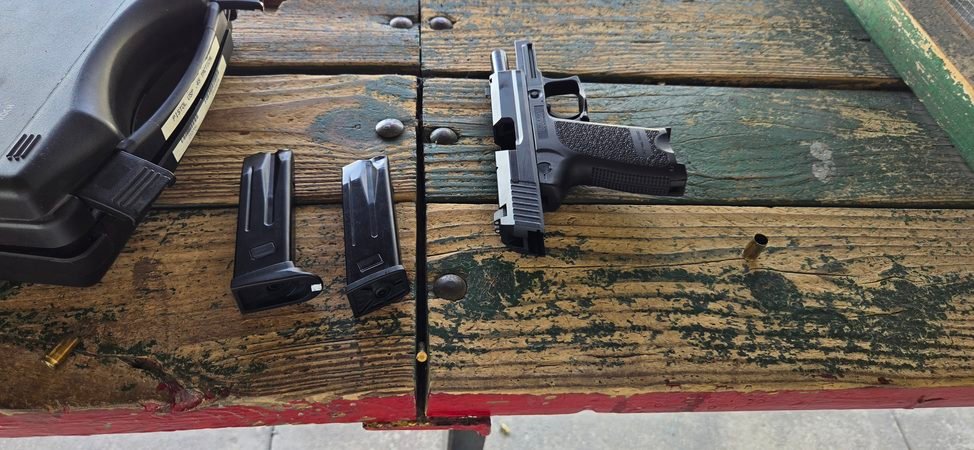
USP: Conversion from .40 to 9mm
By: Kevin M.
The HK USP (Universal Self-Loading Pistol) is a German engineered handgun built from the ground up for what was, in the early 1990s, the hot new cartridge on the market: .40 S&W. Positioned as a middle ground between the 9mm and .45 ACP, the .40 S&W brought higher chamber pressures and accelerated wear. While other manufacturers simply modified existing 9mm frames to fit the round, Heckler & Koch engineered the USP specifically to absorb that extra abuse. Ironically, while the USP platform went on to achieve massive success, the .40 S&W cartridge eventually lost market dominance as modern 9mm loadings improved, prompting major agencies like the FBI to transition back to 9mm.
My search for a USP ended when I spotted a Compact model (USPC) in .40 S&W, complete with the original HK Universal Tactical Light (UTL). Because of its proprietary mounting footprint, the UTL fits only factory USP rails and has since been outclassed by modern weapon lights, making it a neat piece of retro history. The shop originally asked $850, but after some polite haggling, I walked out the door paying $790. Since it came with only one magazine, I stopped by another local gun shop, found a box of HK USPC magazines, and picked up a few extras for $30 apiece.
With my total investment sitting at roughly $850, reality set in: training regularly with .40 S&W gets expensive fast. I turned to the internet to see if converting a .40 to 9mm was viable, and the process proved surprisingly straightforward. Conversion typically requires a drop-in conversion barrel, sometimes paired with a lighter recoil spring assembly. I opted to swap just the barrel while running hotter 124-grain 9mm ammunition to ensure reliable cycling.
The only manufacturer offering conversion barrels without a massive lead time was EFK Fire Dragon. Eager to order, I rushed through the checkout process until the “Order Received” screen popped up. Shortly after, panic set in when I realized I had accidentally ordered a barrel for a full-sized USP rather than the Compact. I quickly found the correct USPC SKU and emailed customer service, hoping they would catch the error before shipping. Fortunately, customer service responded the same day and updated my order.
Putting the Conversion to the Test
A week later, the package arrived. I field-stripped the USPC, swapped the factory .40 S&W barrel for the EFK 9mm conversion barrel, and reassembled the slide. On the topic of feeding: while dedicated 9mm magazines are recommended for absolute defensive reliability, the factory .40 S&W magazines retain and feed 9mm rounds well enough for casual range trips.
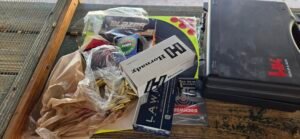
Caption: The test lineup: HK hard case alongside boxes of Speer Lawman, Hornady, and Blazer range ammunition.
I brought a diverse spread of ammunition to the range to evaluate function: Speer Lawman, Monarch, Hornady TAP, Black Hills 124gr +P, and Sierra 124gr JHP.
The conversion barrel chewed through almost everything, but the setup wasn’t entirely without friction. The Hornady TAP consistently underperformed, resulting in clear stovepipe malfunctions where the empty casing failed to fully clear the ejection port.
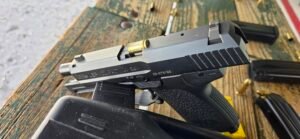
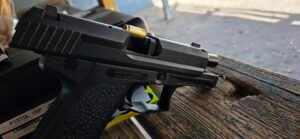
Caption: Left and right views of the Hornady TAP spent casing stovepiping in the USPC ejection port.
Aside from the picky Hornady rounds, any other minor feeding issues were expectedly traced back to using the wider .40 S&W magazine feed lips instead of dedicated 9mm mags.
Final Thoughts
Ultimately, the quick barrel swap made shooting 9mm out of the USPC significantly more affordable—and owning a dream gun has been an incredible experience. Growing up playing Metal Gear Solid 1 & 2, watching 24, and loving Collateral made this a bucket-list pickup. Although Tom Cruise used the full-sized .45 USP in the film, the sentiment remains the same.