
“What’s in a name? That which we call a rose by any other name would smell as sweet.” – Shakespeare
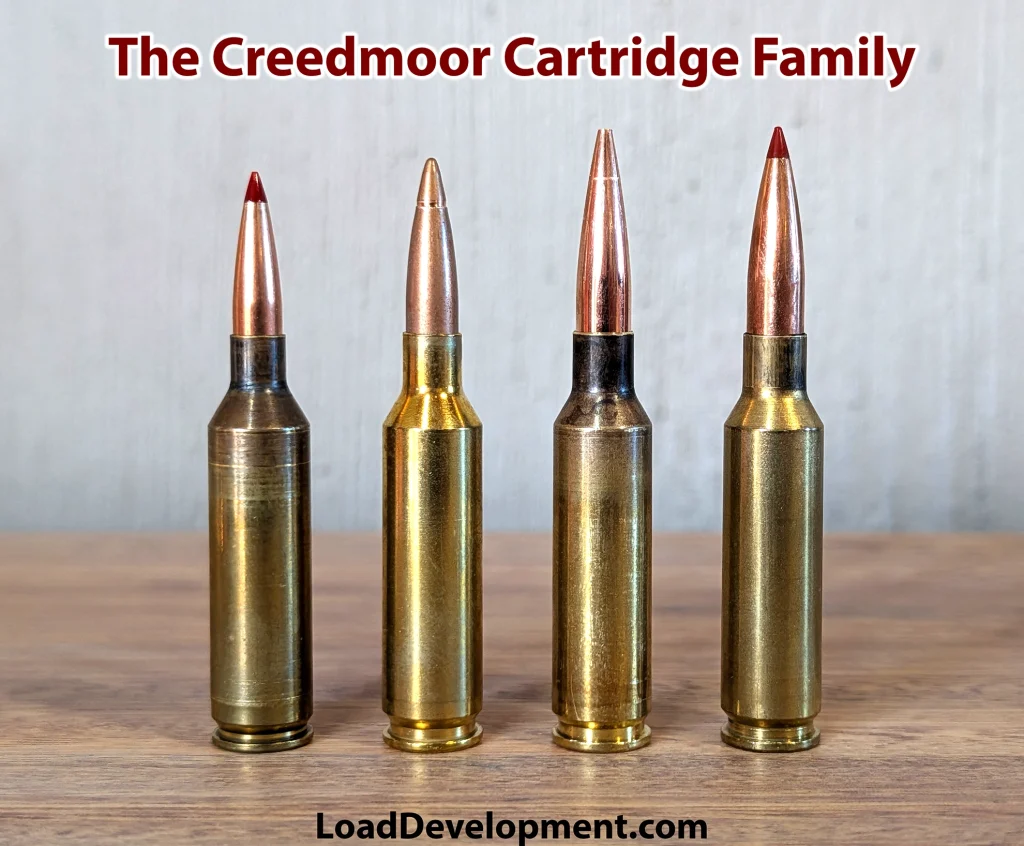
The name Creedmoor inspires hope or hate depending on who you ask. In this article we’re pitting all 4 Creedmoor cartridges against each other to figure out which one is truly the “best”. Because all of them are light recoiling, flat shooting, and excellent match cartridges, we cannot compare them just based on trajectories and wind drift. Instead, we are going to focus on real-world applications. Specifically, we are going to compare off-the-shelf hunting loads then describe the ultimate dedicated rifle concept for each cartridge.
(Note: For the purposes of this article, we are going to exclude +Peak cases. At the time of writing, 6.5 Creedmoor is the only case traditional brass case this technology has been applied to, making performance gains across the rest of the cartridges speculative at best. Furthermore, because the +Peak cases aren’t widely available to every shooter yet, either due to ammo or rifle availability, keeping our comparisons focused on standard factory brass ensures a fair playing field.)
Welcome to the Family
The Firstborn Golden Child
If you poke around on the internet this cartridge is simultaneously barely enough for a coyote and capable of taking a bull moose at 1000 yards. The reality is somewhere in the middle. Some of the more popular hunting loads include a Hornady 143gr ELD-X at 2700 fps, Barnes 127gr LRX at 2850 fps, and the Nosler 142gr ABLR at 2600 fps. All of these are respectable velocities and are more than capable of taking out mule deer out to 400-500 yards and elk at closer ranges. (Please take a moment to leave your furious comments below and fuel the algorithm—thank you.)
Regardless of your opinion on its capabilities, the 6.5 Creedmoor is easily one of the most influential cartridges of the 21st century. From the dimensions of the cartridge itself, to the improved chamber design that is now common in almost all newly developed rifle cartridges, the 6.5 Creedmoor has left its mark and that is reflected in its sibling cartridges. 6.5 Creedmoor fits into a “one-size fits all” style rifle well. By well, I mean that for some applications it is going to be a little tight, like elk and moose, and for other applications it’s going to fit very loose, like varminting smaller than coyotes. But for antelope, deer, and other similar medium game, it is going to be an excellent option.
The Forgotten Middle Child
Have you ever heard the phrase, “Children are like pancakes–The first one is always a little weird”, well that goes for cartridges as well. The 6.5 Creedmoor leaves some want in those velocity numbers and some people would like a little more variety in bullet weights. What if we could bump up the velocity, shoot a little flatter, and get even less recoil? Launching a 103gr Hornady ELD-X at 3000 fps, the Barnes 95gr LRX at 3150 fps, and the Nosler Accubond at a blistering 3200 fps, the 6mm Creedmoor is a high-performing and well-rounded cartridge while still staying above the .24 minimum bore diameter that exists in many states for Big Game. Putting aside big game loads, an 87gr VMAX at 3200 fps is some potent medicine for a coyote at any reasonable distance. Basically anything you’re comfortable pointing the long established 243 Win at, this will do the same job with heavier bullets, higher ballistic coefficients, and higher velocities in many cases.
I dubbed the 6mm Creedmoor the “forgotten middle child” because it exists in both a weird space in the Creedmoor family and in the 6mm family. Other such members of the 6mm family are 243 Win, 6mm ARC, 6mm Dasher, and 6mm GT. The 6mm Creedmoor doesn’t fit in well with any of them. It is a little too fast for some matches with steel targets and more recoil than the ARC, Dasher, or GT. On the other side of the spectrum, rarely will you find it loaded with lightweight “pelt-friendly” varminting bullets like the 243 Win or ARC. So it lives in this niche of people looking for a very high performance, but light recoiling rifle, but not wanting to shoot in competitions. However, if you are designing the perfect Western medium game rifle, think antelope, deer, javelina, sheep, this would be an excellent choice for a lightweight mountain rifle without adding too much recoil.
The Little Brother with Big Dreams
If you’re the kind of person that likes seeing a V8 shoved into a Miata, then you’re the target audience for the 22 Creedmoor. It takes extreme performance and shoves it into a tiny cartridge. It launches a Hornady 80gr ELD-X at 3275 fps, a Barnes 65gr LRX at 3550 fps, and a Nosler 70gr Accubond at 3275 fps. The 22 Creedmoor is a laser beam, if laser beams could be deflected by the wind. Yes the velocities are insane, but the bullet weights are also half of the 6.5 Creedmoor. Once again, if we put aside big game loads, Hornady loads their 69gr (nice) ELD-VT at 3550 fps. This is going to be just as capable, if not more-so, than the 6mm Creedmoor similar loading, but I still wouldn’t consider it a “fur-friendly” loading.
The 22 Creedmoor has fantasies of being an all-around big game and varminting rifle like its older brother, but falls short due to light bullet weights. It would be remiss not to mention that Ron Spomer has written on Moose and Elk being taken in Alaska with .223 Remington every year, and Tyler Freel (in)famously shot a Grizzly Bear with a 22 ARC. To say those are less-than-ideal circumstances would be an understatement. 22 Creedmoor is going to shine for the person that is building a dedicated coyote, and maybe ground-squirrel, rifle and able to hunt pronghorn and whitetail every year, or at least very often. Which begs the question, what if we wanted to balance this game of velocity, wind-drift, and enough bullet weight to take an elk?
The Hidden Genius
The youngest child in the family was only announced in April of 2025. It provides the balance between bullet weight, velocity, and wind-drift that we are looking for. As of this post, Hornady is the only major manufacturer loading for it, so we have limited off-the-shelf options to look at. They load their 128gr ELD-X at 2850 fps, their 112gr CX at 3150 fps, and their 95gr ELD-VT at 3250 fps. The ELD-X and CX give you excellent options for antelope, deer, and elk to reasonable distances and the ELD-VT offering gives you an excellent coyote option as well.
This might be one of the best all-around options on the list, if you ignore ammo availability. For those in doubt, look at the venerable 270 Win. It propels a 130gr bullet at around 3000 fps and has felled countless game since its inception. 25 Creedmoor is doing the same thing about 150 fps slower, so you can expect similar performance, but at reduced distances. It will recoil slightly less and shoot a little flatter than 6.5 Creedmoor while pushing bullets a little heavier than 6mm Creedmoor. It also has less wind drift than either cartridge as you will see in the next section. Unlike the 6.5 Creedmoor, where the “one-size fits all” approach is going to leave you wanting in some situations and overkill in others, the 25 Creedmoor offers better varminting options given the bullet diameter. The competitive shooter who wants one rifle to take on their deer and coyote hunts every year will find the 25 Creedmoor perfect.
Visualizing the Differences
(Special thanks to shooterscalculator.com for being free and providing awesome visualizations)
First lets do a basic trajectory comparison of each cartridge. Since Hornady’s ELD-X is the only bullet that all 4 cartridges share, we
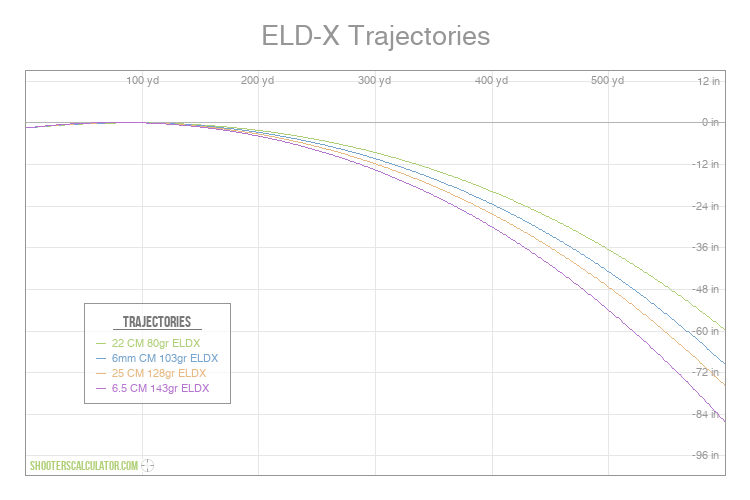
Unsurprisingly, the 22 Creedmoor is the flattest shooting of the set, but trajectory isn’t the whole story. Below are the trajectory tables, which also show wind drift, energy, and time of flight. Each graph goes out to 600 yards, which is the max distance most people would even consider a shot. However, as many surveys have show, the average shot distance is 300-350 yards and in. Each table is at sea level and a 10 mph 90 degree wind.
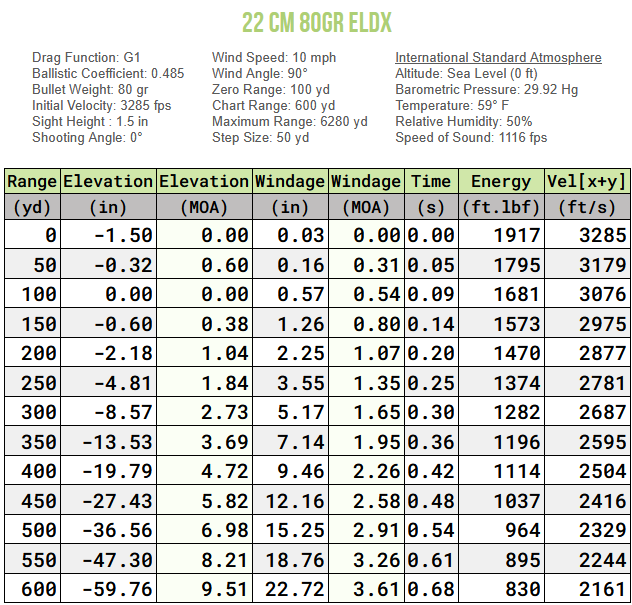
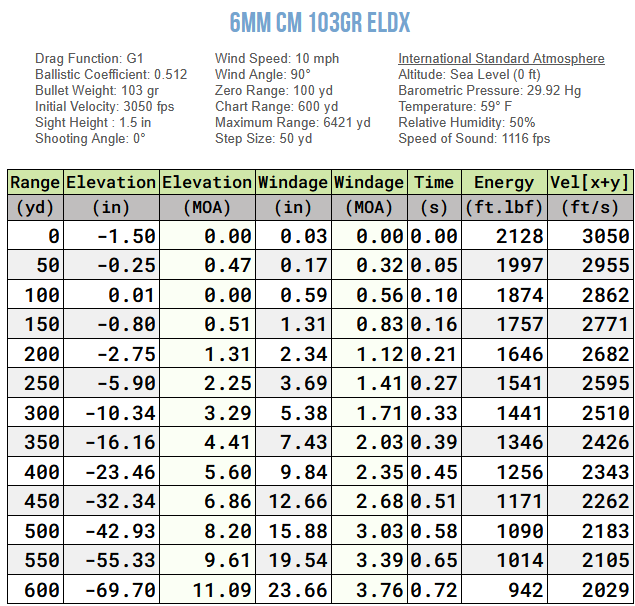
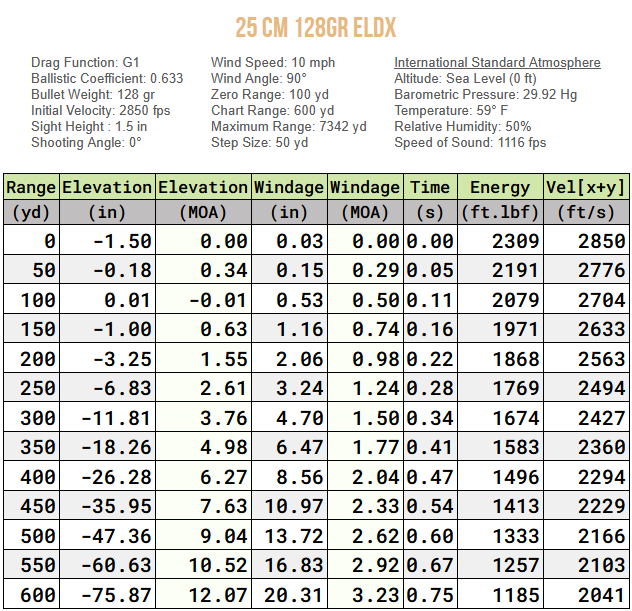
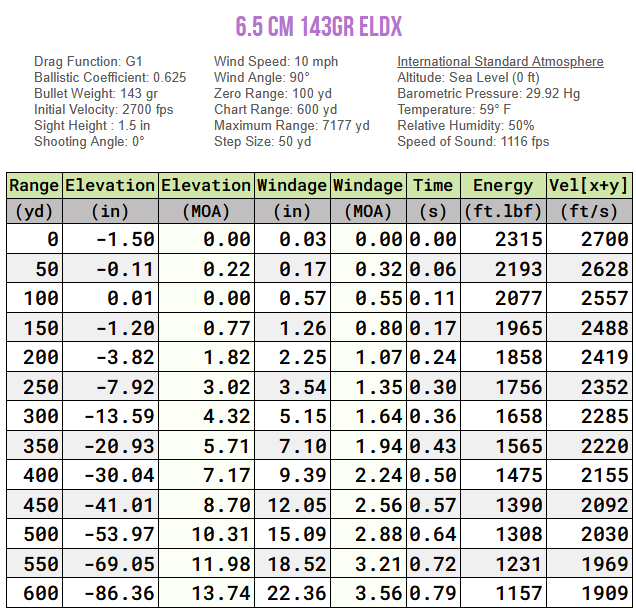
While I do not subscribe to the minimum energy argument, comparing energy between cartridges is useful for comparing efficiency and how much every is available for the bullet to use at different distances. Of particular note, is 25 Creedmoor. At 600 yards it carries the most energy, it has the least wind drift, and with modern rangefinders and reticles, elevation adjustments are as easy as a quick dial.
The final metric we are going to compare is Maximum-Point-Blank-Range. A simple calculation that many hunters use to calculate the maximum range to where you can point and shoot and your bullet will stay within a specified target zone. In simpler terms, if my MPBR is 300 yards for a 6 inch target, then I know that if I aim at a target anywhere from 0-300 yards, my bullet will never go more than 3 inches higher or 3 inches lower than where I am aiming. If we used smaller targets then we would get shorter ranges. This is useful for comparing truly how flat a cartridge shoots. In the examples we are using 6 inch targets, which is useful for deer and antelope.
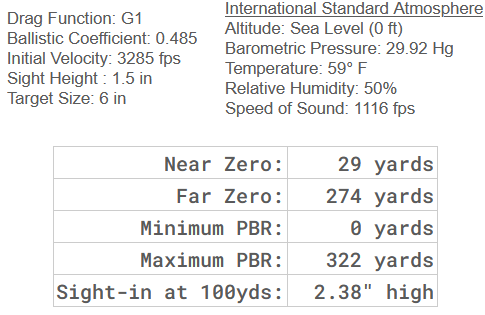
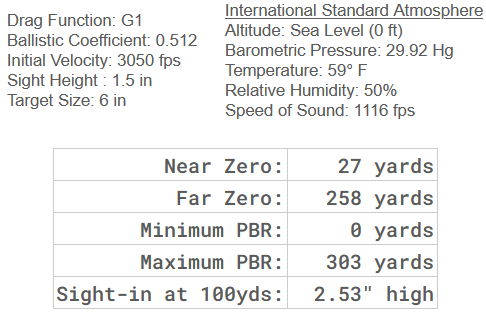
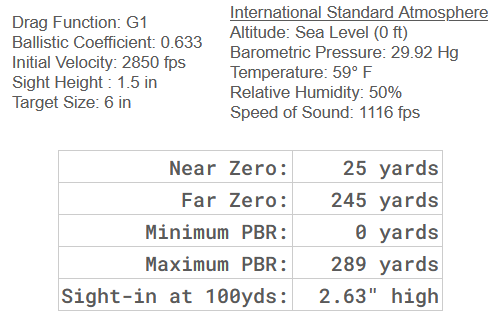
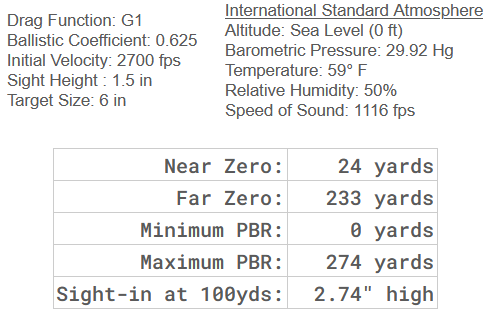
As expected, 22 Creedmoor has the furthest MPBR at 322 yards. However, look at how close the actual numbers are. The difference between a 6.5 Creedmoor and a 22 Creedmoor is only 52 yards. That may or may not make a huge difference for your desired game. Stalking an antelope or mule deer? Probably not. A quick coyote that pops up from the sage brush spontaneously? Absolutely! Context is key for deciding which works for you.
Summary
What is the ultimate do-all rifle? Which Creedmoor comes out on top? These questions are practically identical and share the same answer: It Depends. Rather than chasing an impossible answer, understanding where each cartridge brings to the table yields clear answers:
- 22 Creedmoor: A true varminter’s cartridge. Ideal for someone who chases coyotes year-round and wants that same rifle in hand when out scouting for deer.
- 6mm Creedmoor: The Western Medium Game cartridge. When heavy wind rules out lighter 22 cal bullets, the 6mm Creedmoor steps up to deliver incredibly flat trajectory with better wind deflection.
- 25 Creedmoor: The hidden-gem. Reduced recoil, flat shooting, excellent wind resistance, and enough energy for elk, it balances performance without losing its varminting roots.
- 6.5 Creedmoor: The standard-bearer. If all you need is a deer rifle with off-the-shelf ammo availability, its hard to beat.
At the end of the day, each of these cartridges is an excellent performer and they overlap more than they differ. Success comes down to knowing your rifle and respecting its limits.